
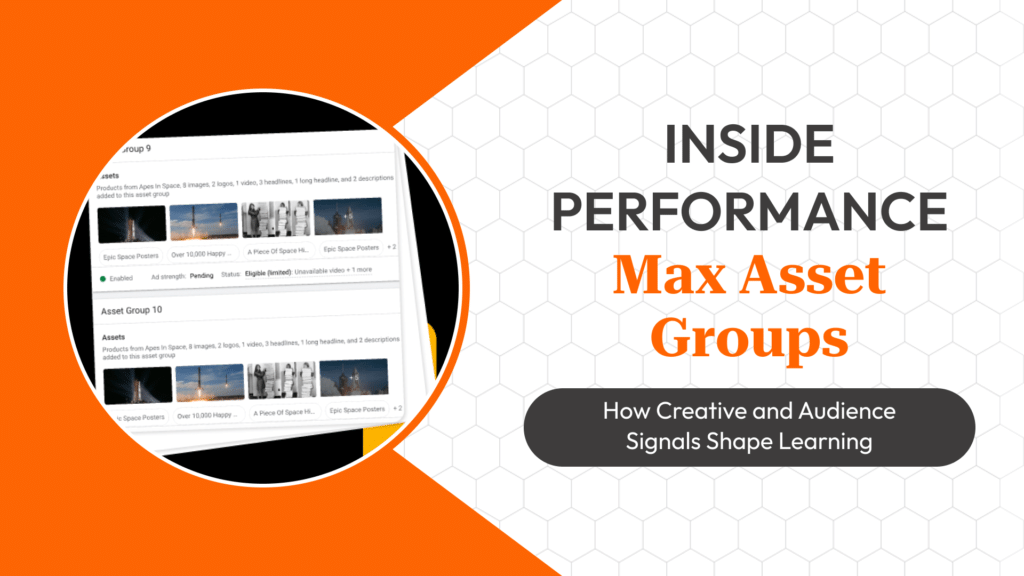
Performance Max removes the granular controls advertisers are used to from Search and Display campaigns, which makes it easy to misunderstand what audience signals and asset groups actually do. They aren’t targeting restrictions — they’re starting hints for an automated system that’s ultimately free to go beyond them if the data suggests it should.
Audience Signals Are Hints, Not Boundaries
Unlike audience targeting in a standard Display or Video campaign, an audience signal in Performance Max — a custom segment, remarketing list, or customer match list — tells the algorithm where to start looking, not where to stay confined. Once the campaign has enough conversion data, it will expand beyond the signalled audience into whatever combination of users, placements and formats the system’s modelling predicts will convert, even outside the original signal entirely.
This is a frequent source of frustration for advertisers expecting Performance Max to behave like manually targeted campaigns — the signal influences early delivery and can meaningfully speed up learning, but it does not cap where the budget ultimately gets spent.
How Asset Groups Actually Structure the Campaign
An asset group is the closest equivalent to an ad group in Performance Max — a collection of headlines, descriptions, images, videos and logos, tied to one audience signal and one final URL expansion setting. Google’s system mixes and matches these assets automatically across all its inventory (Search, Display, YouTube, Discover, Gmail, Maps) to assemble the best-performing combination for a given auction.
Multiple asset groups within one campaign let an advertiser separate genuinely different product lines or audiences, each with its own creative and signal — but they still share the same overall campaign budget and bidding strategy, so asset groups compete with each other for that budget rather than operating in isolation.
Why Creative Volume and Quality Matter More Than in Search
Because Performance Max spans formats that were never text-only, the system needs enough creative variety — multiple headlines, multiple image aspect ratios, at least one video — to actually compete for placements across all its surfaces. An asset group with the bare minimum inputs and a single low-resolution image will simply be excluded from many of the placements where richer creative competes, quietly limiting reach regardless of how good the audience signal is.
Asset group-level ‘Ad strength’ feedback in the interface is a genuinely useful signal here — it specifically flags where the group lacks enough creative diversity to compete broadly.
How Learning Actually Progresses in Performance Max
Similar to Meta, Performance Max needs sufficient conversion volume before its automated bidding and asset combination testing stabilizes — Google generally suggests allowing at least the first few weeks and roughly 30 conversions before drawing firm conclusions or making structural changes. Editing audience signals, adding entirely new asset groups, or changing the bid strategy mid-cycle restarts this exploration in a similar way to a Meta learning-phase reset.
The practical implication is the same discipline that applies to Meta: resist the urge to restructure a campaign in its first one to two weeks based on early cost-per-conversion noise.
Diagnosing Underperformance
When a Performance Max campaign underperforms, the diagnostic order should be: check Ad strength and asset coverage first (is the creative competitive), then check whether the audience signal is too narrow or entirely misaligned with actual buyers, then check conversion tracking quality feeding the bid strategy — since Performance Max’s automated bidding is only as good as the conversion data it’s optimizing against.
Frequently Asked Questions
Can I restrict Performance Max to only show ads to my audience signal?
No — audience signals guide the algorithm’s starting point but the campaign can and typically will expand beyond them once it has enough conversion data.
How many asset groups should one Performance Max campaign have?
Generally one per genuinely distinct product line or audience — asset groups share the same campaign budget, so too many can fragment the learning data each one receives.
Does adding a new asset group reset the whole campaign’s learning?
It can affect delivery stability for the campaign as the system incorporates the new group, though the impact is typically more contained than a full account-level reset.
Why is my Performance Max Ad strength rated ‘Poor’?
Usually insufficient creative variety — too few headlines, missing image aspect ratios, or no video — which limits which placements and formats the asset group is eligible for.
Continue Learning With SG Gurukul
Structuring asset groups and reading audience signal performance correctly in Performance Max is practiced on live accounts inside SG Gurukul’s Performance Marketing Course regularly rated among the Best Digital Marketing Coaching In Indore.