
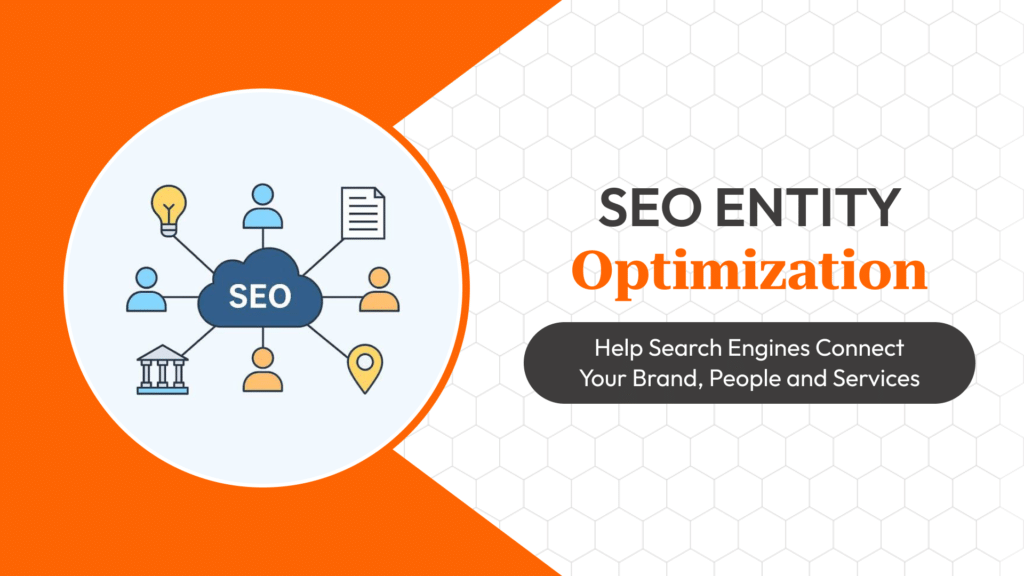
Modern search isn’t purely string matching anymore — Google increasingly reasons in entities: distinct, identifiable things (a brand, a person, a service, a place, a topic) and the relationships between them. Entity optimization is about making those relationships unambiguous to a search engine, so it can confidently associate a business with the specific services, people and topics it wants to be known for.
What an Entity Actually Is in Search
An entity is a uniquely identifiable thing that search engines can recognize independent of the specific words used to describe it — a business, its founder, a specific service it offers, the city it operates in. Google builds its understanding of entities through its Knowledge Graph, drawing on structured data, consistent mentions across the web, and corroborating signals from sources it already trusts.
The practical implication: ranking well for a query increasingly depends not just on keyword relevance on a single page, but on whether Google has confidently connected the business, as an entity, to the topic that query represents — across the whole web, not just that one page.
Structured Data as the Explicit Signal
Schema.org markup — Organization, Person, Service, LocalBusiness, and sameAs properties linking to verified profiles — is the most direct way to explicitly tell a search engine ‘this entity is connected to that entity.’ A Person schema for a founder linked via sameAs to their LinkedIn and other verified profiles, combined with an Organization schema naming that person as founder, gives Google an explicit, machine-readable relationship rather than one it has to infer from unstructured text.
This matters most for E-E-A-T-sensitive niches — healthcare, finance, legal — where Google’s systems specifically look for verifiable connections between content and the qualified person or organization behind it.
Consistency Across the Web as the Implicit Signal
Beyond structured data, entity confidence builds from consistent, corroborating mentions across independent sources — the same business name, service description and location details appearing consistently across the website, Google Business Profile, directory citations, and third-party mentions. Inconsistent NAP (name, address, phone) data or wildly varying service descriptions across these sources dilutes entity confidence, even if each individual listing looks fine in isolation.
Independent third-party corroboration — a mention on a genuinely relevant industry site, a citation in local press, a directory with real editorial standards — carries more entity-building weight than the same claim repeated only on properties the business itself controls.
Topical Authority and Entity Association
Ranking for a broad topic isn’t just about one comprehensive page — it’s about the entity being consistently associated with that topic across a cluster of interlinked, genuinely useful content, corroborated by internal linking structure that reflects real topical relationships rather than generic ‘related posts’ widgets.
This is why a single, isolated 1500-word article rarely outperforms a smaller but genuinely interlinked cluster of pages that each cover a distinct sub-topic and link to each other with contextually relevant anchor text — the cluster builds entity-topic association in a way a standalone page can’t.
A Practical Entity Optimization Checklist
Implement Organization, Person and Service schema with accurate, consistent sameAs links. Audit NAP consistency across the website, Google Business Profile and major directories. Build genuine topical clusters with contextual internal linking rather than isolated pages. And actively pursue mentions on independent, relevant third-party sites rather than relying solely on owned-property signals to establish entity credibility.
Frequently Asked Questions
Is entity SEO the same as structured data?
Structured data is one explicit tool for entity SEO, but entity optimization also includes implicit signals like NAP consistency and third-party corroboration across the web.
How does entity optimization help E-E-A-T?
Clear, verifiable connections between content, the people who created it, and the organization behind it give search engines a more confident basis for assessing expertise and trustworthiness.
Does a Knowledge Panel require entity optimization?
A confirmed Knowledge Panel generally reflects that Google has built sufficient entity confidence about a business, which structured data and consistent citations both contribute toward.
Why does NAP consistency matter for entity SEO if my listings all show the correct info?
Even minor formatting differences (a missing suite number, an abbreviated street name) across sources can weaken the corroboration signal search engines use to confirm it’s the same entity.
Continue Learning With SG Gurukul
Building the structured data, content clusters and citation consistency behind real entity optimization is covered practically inside SG Gurukul’s Digital Marketing Full Stack Course consistently rated among the Best Digital Marketing Institute In Indore.